 TICKETS
 DONATE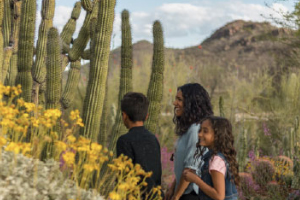


Objectives and Academic Standards
PreK & Kindergarten
A Walk in the Desert
Let’s take an imaginary walk through the desert to discover hidden animals and plants. While meeting some of these fascinating desert dwellers, we will identify the special adaptations each has for survival in this dry environment.
Program Objectives:
Through the examination of live animals, artifacts and interactive demonstrations students will:
- Develop an understanding of some physical characteristics of the desert environment.
- Identify some common Sonoran Desert plants and animals.
- Determine the structures and behaviors of specific desert plants and animals that enable them to live in the Sonoran Desert environment.
- Develop an appreciation for our desert and the creatures that inhabit it.
- Determine measures they can take to help conserve our desert and its life.
Arizona Academic Standards Correlation:
- Science Standards:
-
- K.L1U1.6
- Obtain, evaluate, and communicate information about how organisms use different body parts for survival.
- K.L1U1.7
- Observe, ask questions, and explain how specialized structures found on a variety of plants and animals (including humans) help them sense and respond to their environment.
Active Animals
Get ready to move around and stretch like a snake, pounce like a puma, or breathe like a beaver! Let’s activate our brains and bodies with mindful movements inspired by our animal friends.
Program Objectives:
Through the examination of live animals, artifacts and interactive demonstrations students will:
- Identify some common Sonoran Desert plants and animals.
- Determine the structures and behaviors of specific desert plants and animals that enable them to live in the Sonoran Desert environment.
- Develop an appreciation for our desert and the creatures that inhabit it.
Arizona Academic Standards Correlation:
- Science Standards:
-
- K.L1U1.6
- Obtain, evaluate, and communicate information about how organisms use different body parts for survival.
- K.L1U1.7
- Observe, ask questions, and explain how specialized structures found on a variety of plants and animals (including humans) help them sense and respond to their environment.
Musical Storytime
Learn, laugh, and play! Join us for a fun Sonoran Desert-themed story time, learn fantastic facts, and be ready to move and sing to animal-themed live music!
Program Objectives:
Through the examination of live animals, artifacts and interactive demonstrations students will:
- Identify some common Sonoran Desert plants and animals.
- Determine the structures and behaviors of specific desert plants and animals that enable them to live in the Sonoran Desert environment.
- Develop an appreciation for our desert and the creatures that inhabit it.
Arizona Academic Standards Correlation:
- Science Standards:
-
- K.L1U1.6
- Obtain, evaluate, and communicate information about how organisms use different body parts for survival.
- K.L1U1.7
- Observe, ask questions, and explain how specialized structures found on a variety of plants and animals (including humans) help them sense and respond to their environment.
Elementary
Musical Storytime
Learn, laugh, and play! Join us for a fun Sonoran Desert-themed story time, learn fantastic facts, and be ready to move and sing to animal-themed live music!
Program Objectives:
Through the examination of live animals, artifacts and interactive demonstrations students will:
- Identify some common Sonoran Desert plants and animals.
- Determine the structures and behaviors of specific desert plants and animals that enable them to live in the Sonoran Desert environment.
- Develop an appreciation for our desert and the creatures that inhabit it.
Arizona Academic Standards Correlation:
- Science Standards:
-
- 1.L1U1.6
- Observe, describe, and predict life cycles of animals and plants.
- 3.L2U1.8
- Construct an argument from evidence that organisms are interdependent.
Amazing Arthropods
Introduce students to the incredible diversity of Sonoran Desert insects, arachnids, and other fascinating arthropods. Examine live animals and preserved specimens to learn about anatomy and adaptations. Determine the important roles of various arthropods in desert food chains, pollination, and our ecosystem.
Program Objectives:
Through the examination of live animals, artifacts and interactive demonstrations students will:
- Describe and identify features used to classify arthropods.
- Develop an appreciation of the diversity of Sonoran Desert arthropods.
- Understand the important jobs arthropods play in ecosystems and explain reasons to protect them.
- Identify actions they can take to promote arthropod conservation in their lives.
Arizona Academic Standards Correlation:
- Science Standards:
-
- 1.L1U1.6
- Observe, describe, and predict life cycles of animals and plants.
- 1.L2U1.8
- Construct an explanation describing how organisms obtain resources from the environment including materials that are used again by other organisms.
- 1.L4U1.10
- Develop a model to describe how animals and plants are classified into groups and subgroups according to their similarities.
- 3.L1U1.5
- Develop and use models to explain that plants and animals (including humans) have internal and external structures that serve various functions that aid in growth, survival, behavior, and reproduction.
- 3.L2U1.8
- Construct an argument from evidence that organisms are interdependent.
Saguaro Partners
Did you know saguaros are only found in the Sonoran Desert? Learn how the saguaro is adapted to life here and explore the important partnerships it shares with other living things. Discover how the saguaro depends on animals for pollination and seed dispersal and meet the animals that rely on this giant for shelter and food.
Program Objectives:
Through the examination of live animals, artifacts and interactive demonstrations students will:
- Identify the basic plant structures of the saguaro and describe their functions.
- Trace the life cycle of a saguaro.
- Identify adaptations of the saguaro that allow it to live in the Sonoran Desert environment.
- Describe relationships between the saguaro and other desert plants and animals.
Arizona Academic Standards Correlation:
- Science Standards:
-
- 1.L1U1.6
- Observe, describe, and predict life cycles of animals and plants.
- 1.L2U2.7
- Develop and use models about how living things use resources to grow and survive.
- 1.L2U1.8
- Construct an explanation describing how organisms obtain resources from the environment including materials that are used again by other organisms.
- 2.L2U1.10
- Develop a model representing how life on Earth depends on energy from the Sun and energy from other organisms.
- 3.L1U1.5
- Develop and use models to explain that plants and animals (including humans) have internal and external structures that serve various functions that aid in growth, survival, behavior, and reproduction.
- 3.L2U1.8
- Construct an argument from evidence that organisms are interdependent.
Web of Life
Let’s build a food web to explore how the sun’s energy flows through plant “food factories” to producers, consumers, and decomposers. Meet live herbivores, carnivores, and more to discover the important jobs each living thing performs to provide food or return nutrients to the soil to start the cycle anew.
Program Objectives:
Through the examination of live animals, artifacts and interactive demonstrations students will:
- Develop an understanding of the concept of energy flow.
- Classify Sonoran Desert species according to trophic levels.
- Create a simple food web using Sonoran Desert plants and animals.
- Identify physical and behavioral adaptations that allow animals and plants to survive within their ecological niche.
- Understand the interactions and interdependence among producer and consumer populations within an ecosystem.
- Understand the interactions and interdependence among living and nonliving components within ecosystems.
Arizona Academic Standards Correlation:
- Science Standards:
-
- 1.L2U1.8
- Construct an explanation describing how organisms obtain resources from the environment including materials that are used again by other organisms.
- 2.L2U1.10
- Develop a model representing how life on Earth depends on energy from the Sun and energy from other organisms.
- 3.L2U1.7
- Develop and use system models to describe the flow of energy from the Sun to and among living organisms.
- 3.L2U1.8
- Construct an argument from evidence that organisms are interdependent.
- 5.L4U3.11
- Obtain, evaluate, and communicate evidence about how natural and human-caused changes to habitats or climate can impact populations.
Discover the Desert
In this introduction to the Sonoran Desert, you’ll discover what makes a desert a desert and meet some of the diverse plants and animals that make the Sonoran Desert unique! We will explore the amazing adaptations that help flora and fauna thrive here as we uncover their ecological roles, dispel some myths, and learn how we can protect desert life.
Program Objectives:
Through the examination of desert plants, live animals, and preserved specimens, students will:
- Identify limited water, extreme temperatures, and aridity as challenges to life in the Sonoran Desert.
- Understand that adaptations are heritable traits expressed by populations of organisms through time.
- Describe at least 3 adaptations cacti have that enable them to survive the aridity, scant and variable rainfall, and temperature extremes of the desert climate.
- Describe how native shrubs and trees are adapted for desert survival.
- Develop an appreciation for the behavioral and physiological adaptations resident animals have for desert survival.
- Consider what effects rapid environmental change (i.e. global warming) could have on organisms adapted to specific environmental conditions.
Arizona Academic Standards Correlation:
- Science Standards:
-
- 3.L1U1.5
- Develop and use models to explain that plants and animals (including humans) have internal and external structures that serve various functions that aid in growth, survival, behavior, and reproduction.
- 5.L4U3.12
- Construct an argument based on evidence that inherited characteristics can be affected by behavior and/or environmental conditions.
Middle & High School
Biomimicry: Design by Nature
Biomimicry is an approach to innovation that seeks sustainable solutions to human challenges by emulating nature’s time-tested patterns and strategies. Through experimentation with models, a live animal encounter, and exploration of how animal and plant adaptations have inspired human innovation, students will understand and be inspired to seek solutions to modern sustainability problems.
Program Objectives:
Students will be able to:
- Understand biomimicry and cite examples of how nature’s inspiration can be used for human innovation.
- Investigate and describe some ways in which desert plants and animals are adapted to collect and save water and keep cool.
- Integrate desert plant and animal adaptations into their own designs for a water- and energy-efficient desert dwelling.
Arizona Academic Standards Correlation:
- Science Standards:
-
- 5.L4U3.12
- Construct an argument based on evidence that inherited characteristics can be affected by behavior and/or environmental conditions.
5th Grade — Science and engineering practices;
Analyzing & interpreting data:- Analyze data to refine a problem statement or the design of a proposed object, tool or process.
- Use mathematical thinking and/or computational outcomes to compare alternative solutions to an engineering problem.
- Use evidence (e.g., measurements, observations, patterns) to construct a scientific explanation or design a solution to a problem
- Apply scientific knowledge to solve design problems.
- Construct and/or support scientific arguments with evidence, data, and/or a model.
- Make a claim about the merit of a solution to a problem by citing relevant evidence about how it meets the criteria and constraints of the problem.
- 6.L2U1.13
- Use evidence to construct an argument regarding the impact of human activities on the environment and how they positively and negatively affect the competition for energy and resources in ecosystems.
- 8.E1U3.8
- Construct and support an argument about how human consumption of limited resources impacts the biosphere.
6-8 Grade – Science and engineering practices; Analyzing & interpreting data:- Analyze and interpret data in order to determine similarities and differences in findings.
- Use digital tools, mathematical concepts, and arguments to test and compare proposed solutions to an engineering design problem.
- Use mathematical arguments to describe and support scientific conclusions and design solutions.
- Construct explanations from models or representations.
- Construct, use, and present oral and written arguments supported by empirical evidence and scientific reasoning to support or refute an explanation for a phenomenon or a solution to a problem.
- Essential HS.L2U1.19
- Develop and use models that show how changes in the transfer of matter and energy within an ecosystem and interactions between species may affect organisms and their environment.
- Essential HS.L2U3.18
- Obtain, evaluate, and communicate about the positive and negative ethical, social, economic, and political implications of human activity on the biodiversity of an ecosystem.
Sonoran Solutions: Protecting the Desert
This solution-oriented program asks students to think about ways that they can live in harmony with the natural world around them. We’ll explore some of the biggest threats to life in the Sonoran Desert like habitat loss, invasive species, and the urban heat island effect. This program will illustrate how all of us can make an impact in protecting and conserving our desert home!
Program Objectives:
Students will be able to:
- Describe environmental changes on a global, regional, local, and personal level
- Explain the impact that human beings have had on the ecosystem
- Identify potential ways to address specific ecosystem concerns
- Identify how they can make changes in their own lives that benefit the ecosystem in which they live
Arizona Academic Standards Correlation:
- Science Standards:
-
- 5.L4U3.11
- Obtain, evaluate, and communicate evidence about how natural and human-caused changes to habitats or climate can impact populations.
5th Grade: Science and engineering practice;
Analyzing and interpreting data:- Interpret data to make sense of and explain phenomena
- Use mathematical arguments to describe and support scientific conclusions and design solutions.
- 6.L2U3.11
- Use evidence to construct an argument regarding the impact of human activities on the environment and how they positively and negatively affect the competition for energy and resources in ecosystems.
- 6.E1U1.6
- Investigate and construct an explanation demonstrating that radiation from the Sun provides energy and is absorbed to warm the Earth’s surface and atmosphere.
- 6.L2U3.11
- Use evidence to construct an argument regarding the impact of human activities on the environment and how they positively and negatively affect the competition for energy and resources in ecosystems.
- 6.L2U3.12
- Engage in argument from evidence to support a claim about the factors that cause species to change and how humans can impact those factors.
- 7.L1U1.11
- Construct an explanation for how organisms maintain internal stability and evaluate the effect of the external factors on organisms’ internal stability.
- 8.E1U3.8
- Construct and support an argument about how human consumption of limited resources impacts the biosphere.
- 8.L4U1.11
- Develop and use a model to explain how natural selection may lead to increases and decreases of specific traits in populations over time.
- 8.L4U1.12
- Gather and communicate evidence on how the process of natural selection provides an explanation of how new species can evolve.
- Essential HS.P1U3.4
- Obtain, evaluate, and communicate information about how the use of chemistry related technologies have had positive and negative ethical, social, economic, and/or political implications.
- Essential HS.P4U3.9
- Engage in argument from evidence regarding the ethical, social, economic, and/or political benefits and liabilities of energy usage and transfer.
- Essential HS.E1U1.11
- Analyze and interpret data to determine how energy from the Sun affects weather patterns and climate.
- Plus HS+E.E1U1.2
- Develop and use models to describe how variations in the flow of energy into and out of Earth’s systems result in changes in climate.
- Plus HS+E.E1U1.3
- Analyze geoscience data and the results from global climate models to make evidence-based predictions of current rate and scale of global or regional climate changes.
- Essential HS.E1U3.14
- Engage in argument from evidence about the availability of natural resources, occurrence of natural hazards, changes in climate, and human activity and how they influence each other.
- Plus HS+E.E1U3.9
- Construct an explanation, based on evidence, for how the availability of natural resources, occurrence of natural hazards, and changes in climate have influenced human activity.
- Plus HS+E.E1U3.11
- Develop and use a quantitative model to illustrate the relationship among Earth systems and the degree to which those relationships are being modified due to human activity.
- Essential HS.L2U3.18
- Obtain, evaluate, and communicate about the positive and negative ethical, social, economic, and political implications of human activity on the biodiversity of an ecosystem.
- Plus HS+B.L4U1.2
- Engage in argument from evidence that changes in environmental conditions or human interventions may change species diversity in an ecosystem.
- Essential HS.L2U1.19
- Develop and use models that show how changes in the transfer of matter and energy within an ecosystem and interactions between species may affect organisms and their environment.
All Ages & Community Outreach
Desert Reptiles
From lizards, to tortoises, to snakes, meet the remarkable reptiles of the Sonoran Desert. Compare their diverse strategies for movement, defense, and feeding. Discover the unique adaptations that make them hardy desert survivors.
Program Objectives:
Through the examination of live animals, artifacts and interactive demonstrations students will:
- Identify the basic characteristics of reptiles: scales, ectothermy, and leathery eggs.
- Understand the adaptations and ecological roles of three different reptiles found in the Sonoran Desert region.
- Describe one way that they can protect reptiles in their communities.
Winged Wonders
Which desert animals have the power of flight? Certainly not humans! Birds, bats, and bees can fly — but how? Let’s take a look at our winged wonders, how they manage to get airborne, and discover how they use the power of flight for their unique roles in our desert ecosystem.
Program Objectives:
Through the examination of live animals, artifacts and interactive demonstrations students will:
- Identify the differences between the wings of insects, bats, and birds and how they produce flight.
- Understand some of the roles of flighted animals in ecosystems as pollinators, seed spreaders, predators, and more.
- Acquire an appreciation for our desert and the diversity of creatures that inhabit it.
Drawing Desert Life
Get your drawing tools and paper ready! In this interactive class we’ll learn to observe the natural world around us and draw desert life. Sharpen your observation skills and have fun as you meet and draw the flora and fauna of the Sonoran Desert!
Program Objectives:
Through the examination of live animals, artifacts and engaging with their own illustrations, students will:
- Recognize how basic shapes are found in everything around us.
- Make careful observations of animal and plant adaptations and incorporate them into drawings of these organisms.
- Acquire an appreciation for our desert and the diversity of creatures that inhabit it.
Meet the Neighbors
Sonoran Desert dwellers share the desert with many plants and animals. Let's explore the lifestyles and beneficial roles of some animal residents and learn how to be good neighbors with wildlife!
Program Objectives:
Through the examination of live animals, artifacts and interactive demonstrations students will:
- Identify structures and behaviors that plants and animals employ for survival in our desert.
- Understand the importance of plants and animals and their unique roles in desert ecosystems.
- Acquire an appreciation for our desert and the diversity of creatures that inhabit it.
- Learn how we can be good stewards of our desert ecosystem.