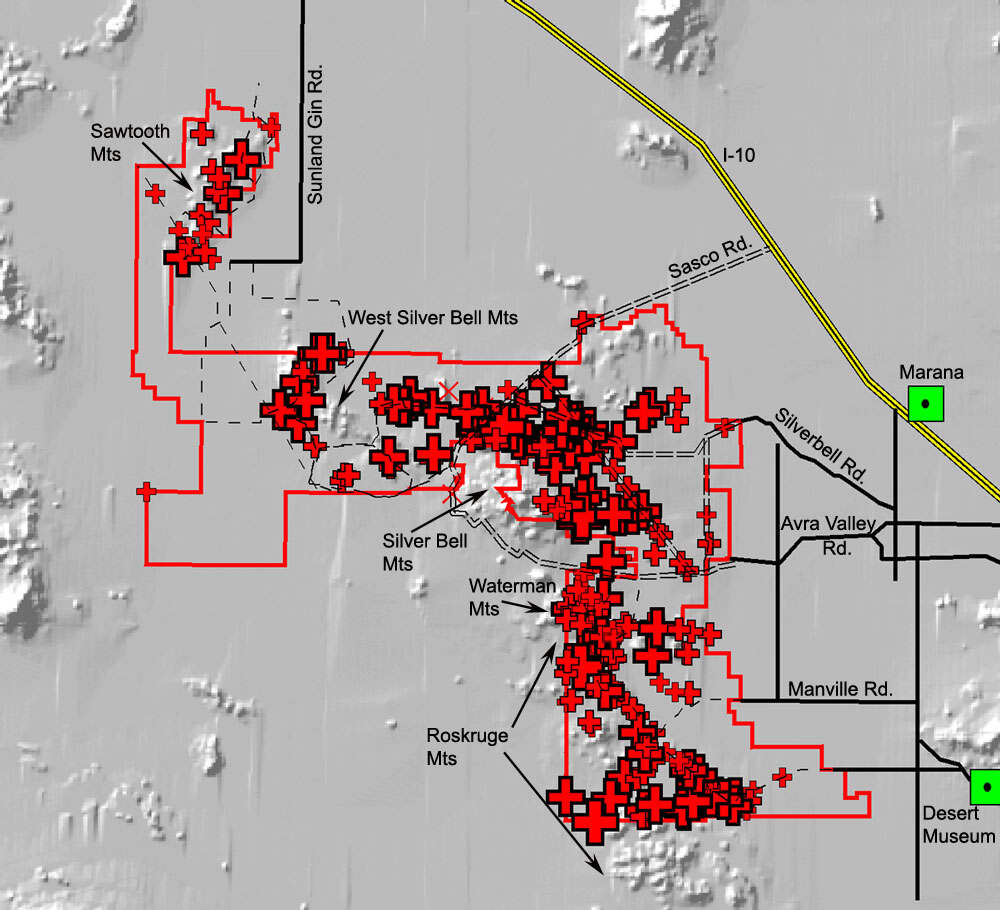
This chapter contains details on the distribution of cacti in the Monument that were not included in the original report. See the cactus gallery for images of most taxa.
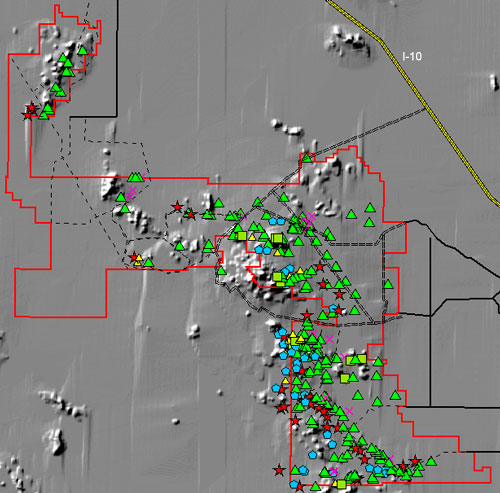
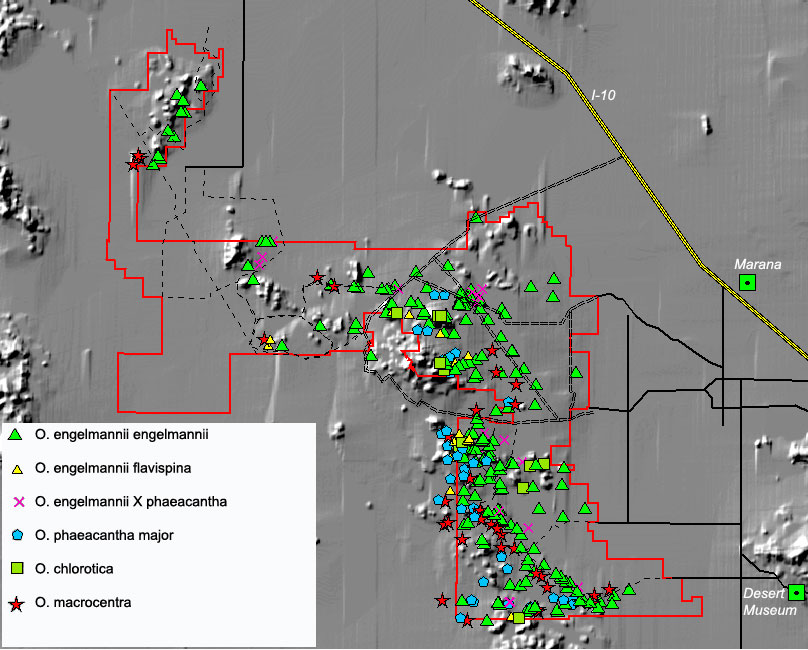
Distribution of prickly pears in Ironwood Forest National Monument. See full-size map for legend. Some symbols have been displaced to avoid overlap with others; all locations are within the IFNM boundary. Prickly pears are distributed on bajadas and mountain slopes and uncommon to absent in the valley floors. The many localities of O. macrocentra are particularly interesting. The species ranges from here eastward to Texas, but it is completely absent from the Tucson Mountains (Saguaro National Park), which are 20 miles east of IFNM and geologically identical to parts of IFNM. (The Tucson and Roskruge Mountains are both part of the same volcanic caldera rim.) |
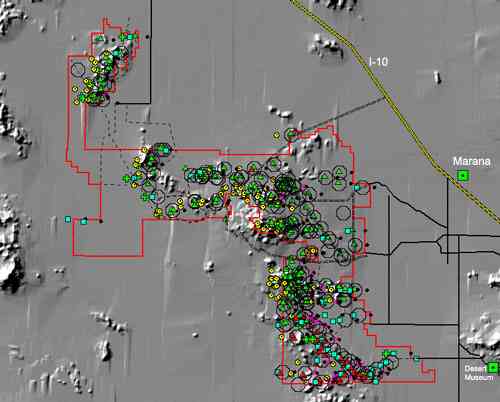
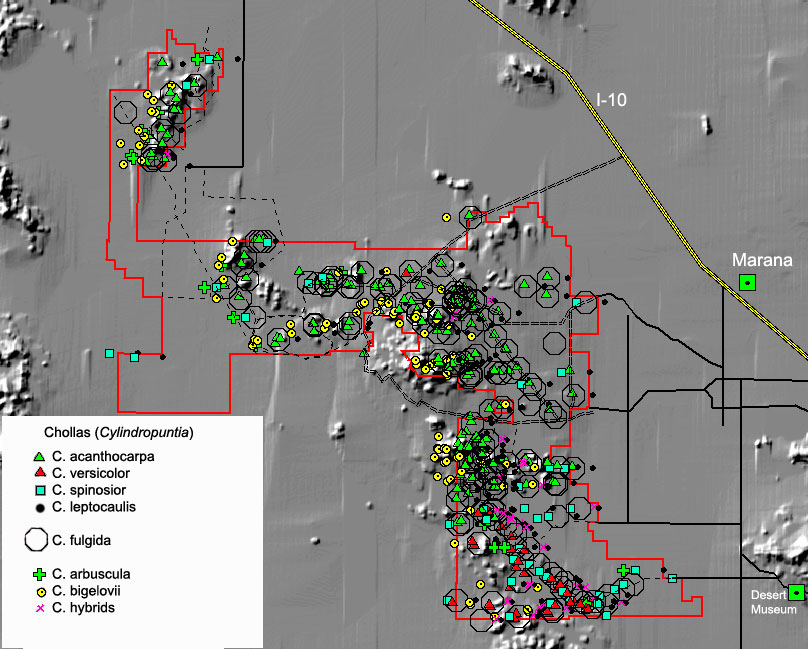
Distribution of cholla species in Ironwood Forest National Monument. See full-size map for legend. Some symbols have been displaced to avoid overlap with others; all locations are within the IFNM boundary. The most interesting distributions are those of buckhorn and staghorn chollas. See next map for explanation. |
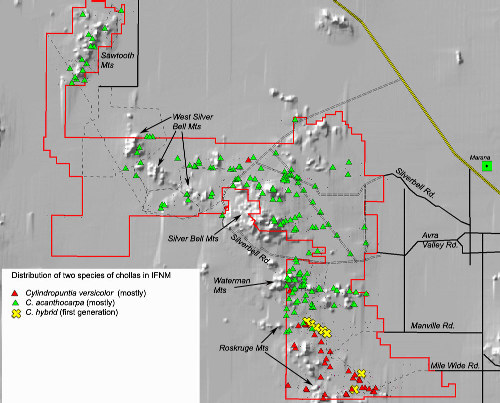
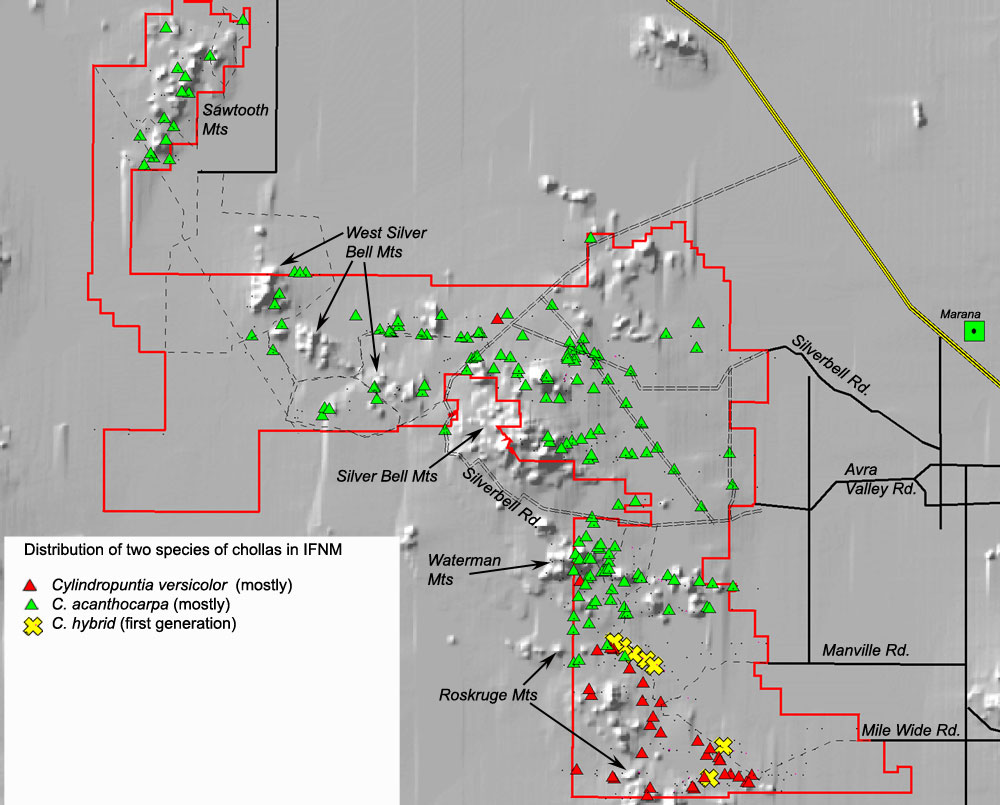
Distribution of Cylindropuntia acanthocarpa and C. versicolor in Ironwood Forest National Monument. Buckhorn cholla (C. acanthocarpa, green triangles) is widespread and common in most of the Monument, but it is almost completely replaced by staghorn cholla (C. versicolor, red triangles) in the Roskruge Mountains. Actually, most of the plants south of Silverbell Road (and some elsewhere) show introgression, and the triangles represent plants that are mostly the indicated species. A similarly anomalous distribution occurs in the Tucson Mountains. There buckhorn cholla occurs on the west side of the range, and staghorn on the east side. |
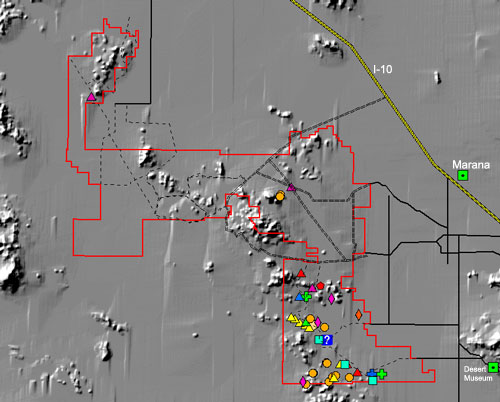
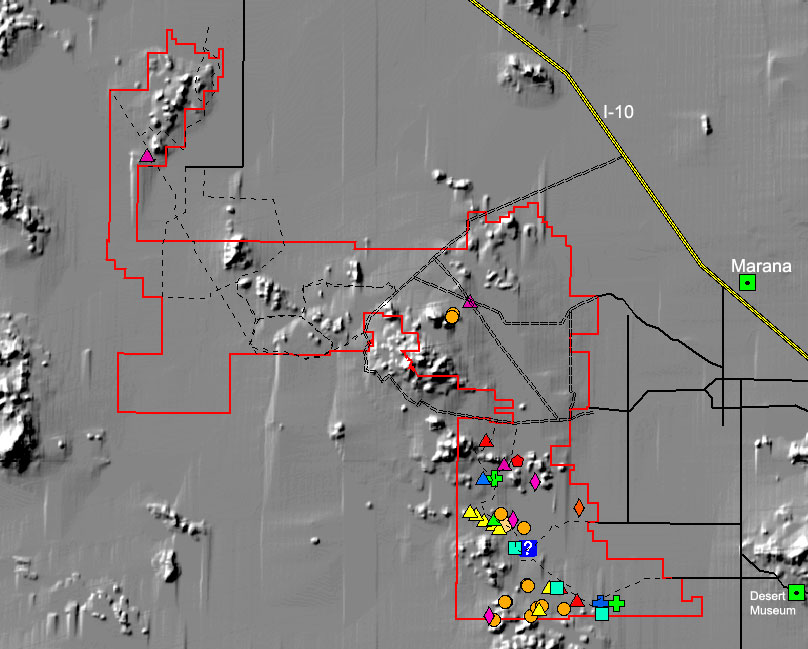
Distribution of cholla hybrids in Ironwood Forest National Monument. Most diploid chollas can hybridize with one another. Considering that the several diploid species are distributed throughout the area, it is unclear why hybrids are concentrated in the southern third. The numerous hybrids represented by the different symbols are not labeled here. |
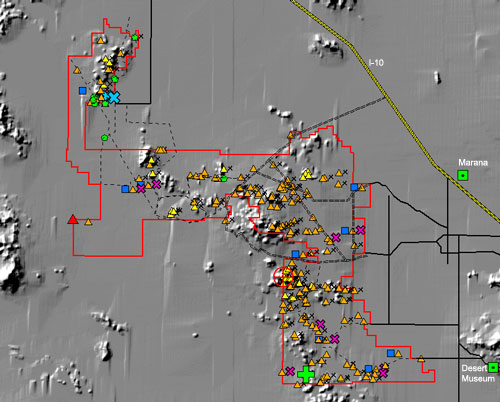
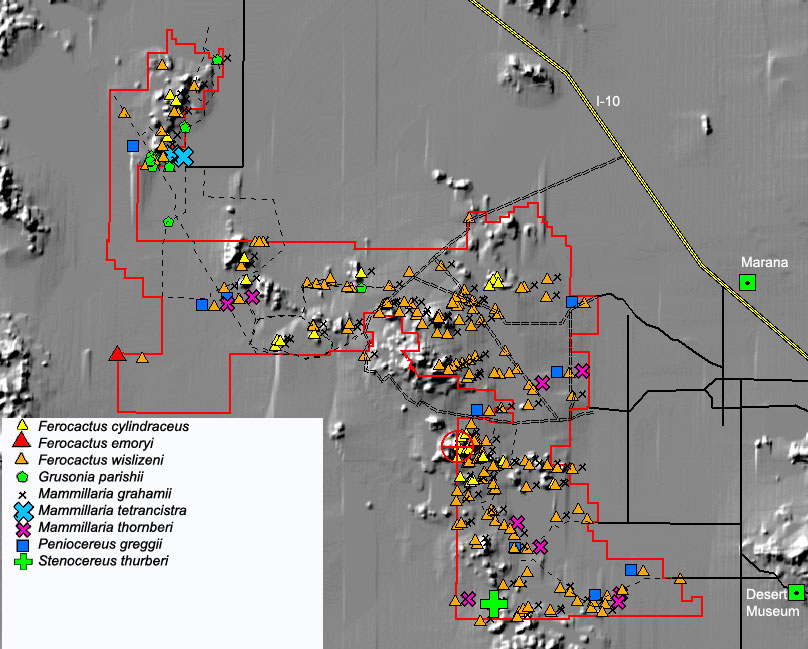
Distribution of other cacti in Ironwood Forest National Monument. See full-size map for legend. Some symbols have been displaced to avoid overlap with others; all locations are within the IFNM boundary. |
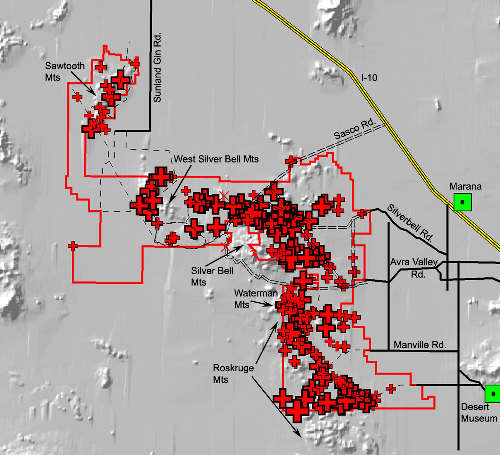
Distribution of saguaros in Ironwood Forest National Monument. The sizes of the symbols indicate relative density from rare to abundant. Saguraos are most common on bajadas and lower slopes. In more arid habitats to the west they shift off the slopes and onto valley floors. |
 TICKETS
 DONATE