 TICKETS
 DONATE





Earth Sciences
Geology is often viewed as a static science, in contrast to the "life sciences" of biology. Yet the earth's surface behaves as if it were a living, squirming organism, constantly reshaping itself, forming new habitats and altering others, providing much of the momentum of natural selection and the resulting diversity of life.
Geology Overlook
At the Geology Overlook visitors enjoy the expansive view over Avra Valley and its neighboring mountains, in the very midst of this process of uprising, shifting, and erosion. Also visible from the overlook is Brown Mountain and its stratified rocks dating to the time of the dinosaurs. Nearer to our times, only 12,000 years ago, were the camel and mammoth whose bones and tracks were found protruding from an arroyo's bank in the valley.
Earth Sciences Center
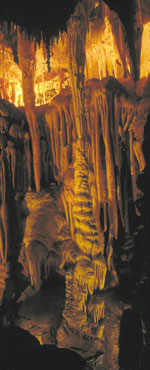
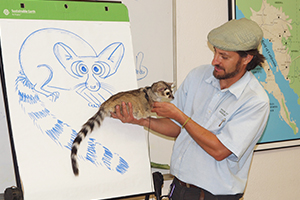
Bright sunlight fades as you descend the gentle incline into ASDM's utterly convincing artificial cave. A yielding wall of cool air parts to let you inside, and the blackness seems total at first, until your eyes adapt and you begin to make out the dim silhouettes of arches and side chambers. Along this passage, the mechanisms and residents of a rarely seen environment are revealed within pools of light that lead you from each display to the next. One charts the development of a limestone cave and the formation of stalagmites and stalagtites, another shows the animals that frequent the twilight zones of cave entrances: bobcats, pack rats, ringtails, and barn owls.
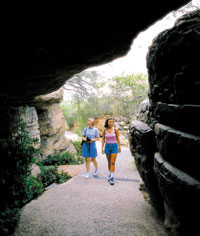
A side tunnel, posted with a warning for those with claustrophobic tendencies, provides a realistic caving experience in 75 feet of sinous, low-clearance maneuvering. It's the delight of children whose trepidatious parents feign disinterest and stick to the main passage. A little farther, the sound of burbling water invites a peek into an adjacent room, revealing a glistening mass of cave formations, gently floodlit from beneath the surface of a turquoise pool.
The cave exhibits lead to a room containing a NASA-funded Earth from Space: A Satellite's View of Earth exhibit, where videos reveal a satellite's view of wildfire, drought, water, extreme weather, and other large-scale changes on our planet. This exhibit is surrounded by a sweeping circle of backlit globes depicting the birth of our world.
Moon Rock
The desert landscape we see today is the result of an extraordinary history! One that stretches back to the very formation of Earth and our Solar System. Its story is written in ancient rocks, windswept sands, and cosmic connections that span billions of years.
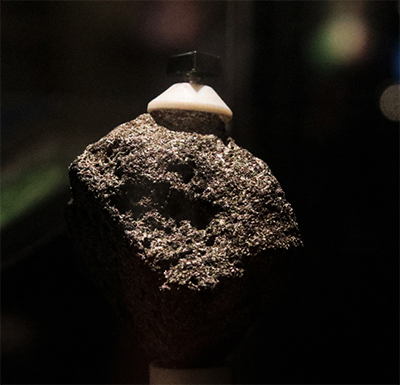
We are proud to be one of the few institutions worldwide to display an authentic Moon rock collected by Apollo astronauts. This remarkable specimen—a 169-gram (6 oz.) piece of high-titanium basalt—is estimated to be 3.8 billion years old. It was gathered near the southwestern rim of Crater Camelot, close to Mare Serenitatis (the "Sea of Serenity")—the region we recognize as the "left eye" of the Man in the Moon.
To preserve its pristine condition, the Moon rock is permanently sealed in a nitrogen-filled container, protecting it from Earth's atmosphere and preventing oxidation. It offers visitors a rare and powerful glimpse into the origins of our solar system.
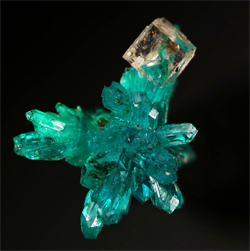
In an adjacent hall, part of the Museum's breathtaking mineral collection glows in crystalline hues of ruby , amethyst, and emerald. Thus the visitor to ASDM's earth sciences center has been treated to a full spectrum of the truly "living" science of geology - from the raging forces that create wonderlands in the underground caverns, to the jewel-like products of tremendous tectonic forges.
Mineral Collection Tour
The Desert Museum's permanent mineral collection has been touted as one of the finest regional mineral collections in the world. The strength of the collection lies in the museum's narrow focus of attention: minerals from the Sonoran Desert region of Arizona, Sonora and Baja, California. Don't miss this stunning collection on your next visit to the museum. In the mean time, we invite you to browse through the following collection of ten minerals along with a bit of information about each.