 TICKETS
 DONATE


Grazing Project
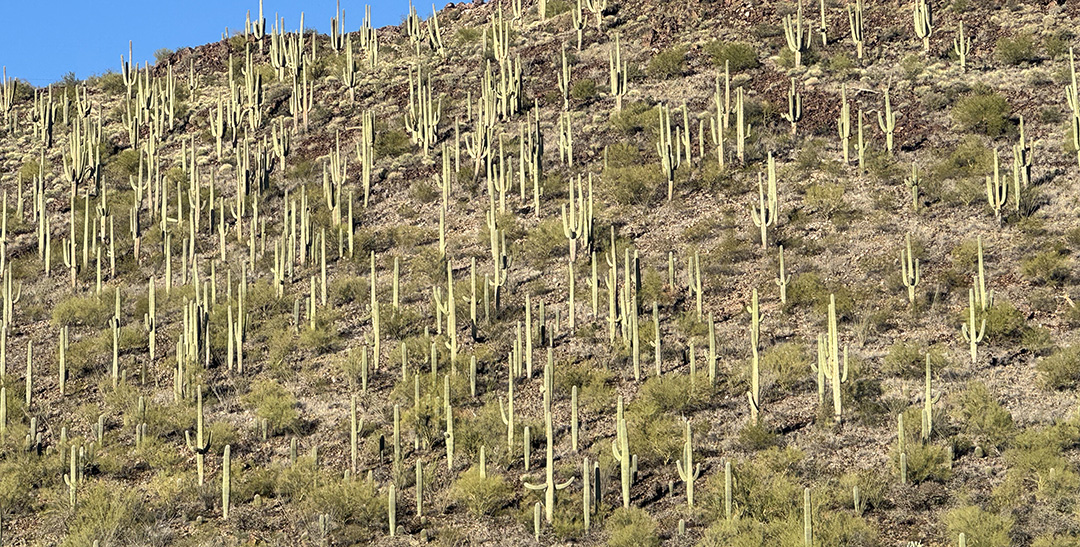
Sheep are on 'A' Mountain to eat invasive buffelgrass plants. The Arizona-Sonora Desert Museum has secured grant funding and partnered with The City of Tucson to see how sheep can help control buffelgrass. We want to remove buffelgrass because it crowds out desert plants, like saguaros, and is prone to serious fires. If sheep can help remove buffelgrass, we won't need to use as much herbicide to get rid of these plants. Sheep will be grazing in small, contained paddocks for about a month during the spring of 2025.
Frequently Asked Questions
- The sheep are here as part of an invasive species and wildfire abatement program.
- Buffelgrass has invaded Sentinel Peak Park (A Mountain) and brings increased risk of hotter and more frequent wildfires.
- The sheep are here to graze the invasive grass in preparation for spraying, which will occur after rain causes the grass to "green-up".
About one month.
15
Navajo-Churro sheep
Four hundred years ago, the Churro sheep were brought from Spain to the Navajoland. This flock was bred and raised in Tombstone. They are a drought tolerant breed and considered extremely hardy.
Yes, feel free to safely take photos from a distance.
We ask that the public refrain from going near the herd and the electric fence for their own safety and for the safety of the sheep.
- Predation is a risk with any ranch or domesticated herd animals.
- There have not been mountain lions seen in the area in the last year, although there is a slim possibility of coyote attacks.
- A predator would have to make their way through an electrified net to get to the sheep. And they will have a herder nearby.
- Dogs are the main concern. We ask the public to keep their dogs a good distance from the herd.
Due to public access to the area and many dogs potentially running off leash, the decision was made not to use a sheep dog for the herder's and the sheep dog's protection.
- The sheep will have a herder watching the flock.
- There is an electric fence surrounding the herd, and each animal has a collar that administers a mild shock if the sheep somehow wander past the fence line.
- The herders will be available to catch/corral the sheep if they somehow manage to escape the fence boundaries.
Dogs or people getting to close to them. We will have signs asking the public to give the sheep their comfort space.
These are trained, working animals. They are not being raised for meat.
The herder is hauling in drinking water.
Some parts of the buffelgrass-infested slopes are too steep for the sheep and therefore will not be grazed.
Counting sheep might make folks sleepy! Results may vary.
Domestic sheep can transmit diseases to Bighorn sheep, but the closest population of Bighorn is on Pusch Ridge, in the Catalina Mountains, some 15 miles away. The sheep here on A mountain will not be traveling near the existing Bighorn populations, so disease transmission is not likely.
They will eat whatever is available and tastiest to them, but they do not eat trees and saguaros. This is a targeted-grazing project, meaning that we are only targeting certain areas, those where the invasive grass cover is so great that there now remain very few native plants.
To control the spread of buffelgrass we have for the last 20 years been hand-pulling and spraying, but we need another tool. To prevent further spread of buffelgrass, we need to use multiple methods of treatment. Hand-pulling or grazing on its own is not enough. When combining grazing with chemical treatment post-grazing the buffelgrass is far less likely to spread.
By having the sheep eat the majority of the older plant biomass first, the herbicide is far more effective, and a much smaller amount is needed for the treatments after grazing.
Glyphosate, trademark "Roundup". This is the same herbicide that is sprayed multiple times per growing season on the majority of grains, seed oils, corn, potatoes and other produce sold in grocery stores.
The sheep are only grazing areas that are already 60% covered in buffelgrass, and the seeds are already on the soil. In passing though the gut of the animal, there is a much lower viability of the seeds than had they been left on the desert floor.
If touched it gives a shock, but not a dangerous one. When the animals are not in the pens, the fence will be de-energized.
There will be signs indicating it is "hot".
There will be short periods (~20 minutes) when the animals are moving through their fenced corridor that a trail could be temporarily closed.
There should be minimal impact.
The Desert Museum and City of Tucson have been coordinating this project since the fall of 2022. Menlo park's liaison has also been involved since the project's inception in 2022. Multiple entities and strategic planning have led to the last few months of coordination with Sentinel Shadows and Panorama Estates, as well as Tumamoc Hill staff to make this project happen.
The Arizona Department of Fire and Forestry Management issued a grant to the Arizona-Sonora Desert Museum, which is partnering with The City of Tucson Parks and Recreation Department. This part of the ongoing invasive species treatment on A-Mountain.