High School Earth Camp (Entering grades 9-12)
July 6-17, 2013
Earth Camp opens eyes and minds to our unique, interdependent and awe-inspiring planet, drawing connections from our homes, to our region, to the globe, and to what we can learn about Earth from space.
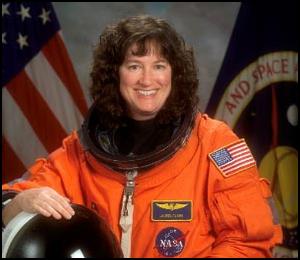
Conceived to honor the legacy of Columbia space shuttle astronaut Laurel Clark, the goal of Earth Camp is to educate and inspire youth to build leadership skills through experiential learning and conceptual understanding of earth processes. Earth Camp seeks to expand youth awareness of the interdependency of all living things, create a sense of wonder related to the Sonoran Desert and ecosystems worldwide, as well as open their eyes to the "awe-inspiring" universal perspective. High School Earth Camp provides hands-on ecological research experience to help youth appreciate how science can be used to help people make better choices in a rapidly changing world.
High School Earth Camp 2013 will challenge youth entering grades 9-12 to explore global changes in climate, water and landscapes as well as how these changes impact sustainability issues. Students will work together in small-groups exploring ecology and water resources from southern Arizona to eastern Utah.
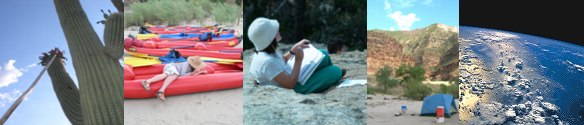
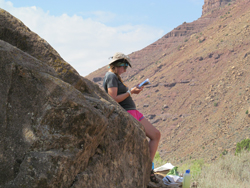
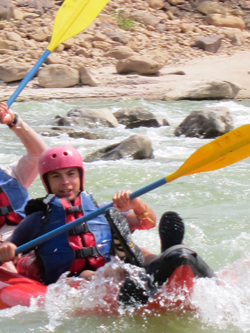
The bulk of our investigations will take place during a 5 day rafting trip down the Green River's Desolation Canyon in Central Utah. Desolation Canyon's 90 river miles offer the perfect venue to study the history of water resource policy, development of the West and its impacts on the flora, fauna and ecology of our region. We will gain an understanding that turning on any faucet in the West has wide ranging impacts that can be felt from the Sea of Cortez to the headwaters of the Green and Colorado Rivers in the Rocky Mountains. As we engage in our own exploration of the Desert Southwest we will gain insights into the work of early western explorers such as Major John Wesley Powell, who in 1869 charted the last unmapped portions of the west, including the Colorado River system and our destination, Desolation Canyon. We will compare and contrast the life and work of early explorers with that of modern day pioneers such as Laurel Clark, and see how even today, in an era of scientific enlightenment, there is ample territory for new exploration and discovery.
Students will be immersed in the ecology of the Sonoran Desert at the Arizona-Sonora Desert Museum where they will have the chance to interact with live animals and learn about the unique qualities of the Sonoran Desert. As we travel north from Tucson to Moab Utah, they will explore several distinct ecosystems as we travel up and out of the Basin and Range of the Sonoran Desert and arrive on the expansive Colorado Plateau and the Great Basin Desert. In our travels we will stop along the way to see sites of natural and cultural significance such as Canyon De Chelly National Mounument, Monument Valley, and the Glen Canyon Dam. Students will consider how past, current and future environmental change will affect them wherever they live and use satellite imagery to analyze the causes and impacts of change at different scales. Upon our return to Tucson, campers will have the opportunity to utilize the vast resources of the University of Arizona where they will assimilate their newly acquired knowledge and understanding of how people use, change and can protect the landscapes we have visited.
During the entire twelve days, campers will record their journey in photos, drawings, observations, data and personal reflections in field journals, which will then be transferred to individual web pages. Campers will compute and evaluate their personal and collective environmental impact and use this ecological footprint to inform future choices.
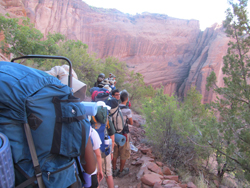
Please note: this is a field excursion and students will camp under the stars (or in tents) in the desert and on the river beaches each night. The river excursion portion of the trip is a genuine wilderness experience and campers will need to come prepared for the rigors of outdoor living and the joys and challenges that come with it.
A Learning Celebration at the end of the camp gives the students an opportunity to share their discoveries with each other and with their families.
Participants are selected by an application process. Applications must be received March 15th. Space limited to 20 youth. Applicants will be notified by April 15th. Camp fee of $1500 for selected participants is due by May 15th. Thanks to generous support from NASA, full and partial scholarships are available.
View a sample of our day by day activities.
For more information call Amy Orchard at 520-883-3083.
Teacher Recommendation FormThe application deadline of March 15th 2013 has passed.
About the Instructors
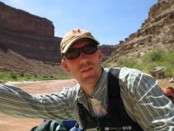 Lynn Orchard holds a Masters of Science degree in Hydrology from the University of Arizona, and a Bachelors of Science degree in Watershed Science from Utah State University, and is currently a Chief Hydrologist for the Pima County Regional Flood Control District where he has worked since 2002. His main area of expertise is in flood hydrology/hydraulics and geomorphology of natural river systems, as related to natural resource management. He has directed research in a broad range of topics including riparian restoration, forest hydrology, paleoflood hydrology, flood frequency, channel response to flow regulation, floodplain evolution, sediment transport, post-fire hydrology, and instream flow requirements for native fish. He recently managed the construction of an 80-acre riparian restoration project in Pima County that included planting over 7,000 native trees. He has coordinated and supervised research in the wilderness canyons of the Green, Colorado, San Juan and White Rivers in Utah, Colorado, and Arizona. Lynn has been a volunteer in the Earth Camp programs for the past several years and enjoys sharing his knowledge and excitement about the natural world with youth. He is a former commercial riverguide, an avid recreational kayaker and a triathlete.
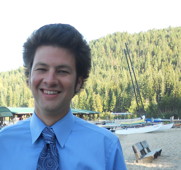 Jacob Prietto is a Water Educator with Arizona Project W.E.T., where he teaches elementary and middle school students about the interesting and important aspects of water, especially here in southern Arizona. Topics of discussion include groundwater flow, watershed management, and the water cycle. He also has a long history working with children in youth sports and youth recreation. Jacob received his Bachelor Degree in Environmental Hydrology & Water Resources from the University of Arizona, with studies emphasized in surface-water hydrology. After graduation, Jacob worked for 5 years as a professional hydrologist in the field of civil engineering, doing watershed studies, floodplain analyses, and stormwater management. His lifelong passion for sports includes playing soccer, basketball, and skateboarding.
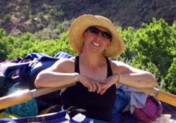 Amy Orchard has worked at ASDM since 2001. She has a Bachelor's degree in Environmental Studies from Prescott College and has over two decades of experience educating youth of the desert southwest about its flora and fauna. Amy currently manages the teen programs at ASDM and has taught natural history to youth groups in numerous exciting locations such as Arches National Park, on raft trips down the Colorado River and in the Catalina mountains. Amy has facilitated youth programs such as a six-year course, which included survival skills and overnight backpacking trips. Amy has been a whitewater river guide. Currently she enjoys knitting, biking, teaching yoga and basking in the Arizona sun.
 Jesús Manuel García was born and raised in Magdalena de Kino, Sonora, México. He completed a degree in Elementary Education, (Escuela Normal del Estado) in Hermosillo, Sonora, and then moved to Tucson and graduated from the University of Arizona with a Bachelor degree in Ecology and Evolutionary Biology, with a minor in cultural Anthropology. Jesús has been associated with the Arizona-Sonora Desert Museum since 1991. Currently, he is an education specialist teaching natural history programs to the Hispanic community of the Tucson area schools as well as in the border region of the state of Sonora, Mexico. Jesús has many interests such as conservation biology, cultural ecology, languages, music, gardening, and art.
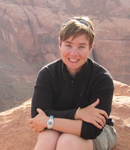 Sanlyn Buxner is the Earth Camp collaborator from the Planetary Science Institute in Tucson, AZ. She holds a PhD in Teaching and Teacher Education with an emphasis in Science Education and currently works with teachers and undergraduate students at the University of Arizona. Sanlyn has over fifteen years experience working in informal education settings including summer camps, after-school programs, star parties, science field programs, family science programs, and outdoor adventure programs. She is a former Middle School Earth Camp instructor and is currently an instructor for the Teacher Earth Camp program. Sanlyn enjoys bicycling, hiking, canoeing, backpacking, and cooking.